
Dear Faithful Reader,
The novelist and creative writing teacher Lou Berney (who is also one of my favorite living writers) was once asked about his approach to working with his students. He replied:
“Honestly, the main thing I do is encourage them.”
I think I’m starting to understand what he meant.
When I started my writers’ coaching program in 2023, I thought it was going to be a way to share knowledge and help people improve their skills. I was wrong. Turns out, as important as knowledge, skills, and experience are, they are not the program’s prime offering.
It’s the caring.
According to those who’ve participated over the past three years, the benefit they find most valuable is the support and encouragement they get. The fact that I genuinely care about the books they are wanting to write — about the outcome being as excellent as it could possibly be, but more than that, too: about them, their lives, their struggles and triumphs.
And not just the caring coming from me, but from the rest of the group, too.
They come for the knowledge — stay for the connection.
Many years ago, my friend and coauthor Dave Krueger told me something I’ll never forget:
“I believe the most basic motivation we have as human beings is to be effective, to be a cause.”
In other words, to feel that we matter.
I’ve referred back to this fundamental truth so often that I’ve come to think of it as “Dave’s Dictum.” And it now occurs to me that there is a logical corollary to Dave’s Dictum:
The most valuable thing you can do for another human being is to show them that they matter.
There’s a word for that: caring.
Of course, it’s one thing to care about those you know and love. That, I think, comes naturally to all of us. Even card-carrying sociopaths have been known to exhibit a surprisingly strong sense of protective concern for a close family member. (A truth spookily explored in Sue Grafton’s T Is for Trespass, my favorite of all her alphabet series.)
But to care about the people you don’t know and love? Those you know only vaguely, those nameless souls you pass on the streets every day? Complete strangers on the other side of the earth?
That’s caring of a whole different order.
There are those individuals who feel so innately connected to humanity that such a level of caring comes naturally, as a calling, even a career. One thinks of Mother Teresa and Diana Spencer, both of whom the world lost within the same tragic week nearly thirty years ago. Of Jimmy Carter, climbing ladders, nail gun in hand, building homes for Habitat for Humanity well into his nineties. Of Chef José Andrés, whose initiative has served over 400 million meals to those in need.
All great faith traditions feature figures who take on the sacred work of caring about everyone on the planet as their life’s work.
But what about you and me? Most of us fall somewhere in the middle on that scale, neither saints nor sociopaths, but just … well, just you and me, doing our best to get on with our lives.
For us, compassion is perhaps less a calling and more an everyday choice. Something we consciously take on — or, at times, shirk from taking on.
This is the choice we are confronted with when we see a tragedy unfold on the news, a killer tornado, deadly monsoon, catastrophic forest fire. A choice we face when we notice that half-hidden look of pain on the face of the person who just served our lunch at the coffee shop. When we learn that a friend we haven’t heard from in a while is going through a rough patch.
Engage, or ignore?
Care, or let it pass by?
Because, let’s be honest: It isn’t always easy. It takes energy to care.
Ask any parent. It’s hard to see your child struggle, fail, fall short, suffer. So much easier to call in a babysitter, sit the kid at the TV, plug them into a phone or tablet or videogame, stick a pacifier in their mouth when they cry.
Hey, it’s easier to stick pacifiers into the mouths of all the people we encounter. “How ya doin’? Good, good, gorgeous weather today, huh?” … and go about our day.
And sure, we’d like to think we will take the noble path. Because we ought to care, right? Of course we ought. And yet.
And yet the truth is more nuanced.
As long as we’re being honest, let’s go a step further, shall we?
Sometimes, we have to triage our caring. Because otherwise it can all become too painful. “Compassion” is not a cozy, cuddly experience. The word literally means “to suffer with.” When you have compassion for another, you take on their struggle, you feel their pain as your own. And that takes a toll.
Compassion comes with a cost.
And here’s something interesting: the word “care” itself grew from old Germanic seed words meaning “wail, grief, lamentation.”
To care is to suffer.
So yes, sometimes we prioritize. We shut off the news, ignore that fleeting shadow of pain on our coffee-shop server’s face, put off putting in a call to that friend — and that choice is in itself painful, because deep down we know we’re electing to consciously turn away from the anguish of others.
Yet the alternatives are to be swallowed by the world’s suffering — or else to shut down altogether.
And choosing that latter route, according to writer, Nobel laureate, and Holocaust survivor Elie Wiesel, means that we die, or at least are no longer truly alive. As he put it in a 1986 interview:
“The opposite of love is not hate, it’s indifference. The opposite of art is not ugliness, it’s indifference. The opposite of faith is not heresy, it’s indifference. And the opposite of life is not death, it’s indifference.”
Here, it seems to me, is the predicament, the paradox, and, perhaps, the pathway through:
We have to care. Compassion for others is not an interruption of nor distraction from the more central business of our lives. It is the central business of our lives.
Yet there are limits to our caring. Because (for most of us, at least) swallowing the world’s pain whole can only lead to despair, the exhaustion of soul and body.
So we do our best … and include in our caring a sense of compassion for ourselves. Perhaps we even start there.
There’s a gentleman in my writing program, Nizam, who is writing his memoir of growing up in Bangladesh during the worst famine of the twentieth century. The story is compelling; Nizam’s language is mesmerizing; yet what strikes me most is the searing honesty of his self-reflection.
He describes passing a boy his own age on the street every day for weeks at the height of the famine:
“I never spoke to him, nor did I ever make intentional eye contact, though our eyes met from a distance more than once. We avoided each other, as if by mutual unspoken agreement. To acknowledge him, to meet his gaze, would be to admit an obligation, to awaken a sympathy and empathy that we could not afford in a world where everyone was begging.”
Finally, one cold day months later, he sees the boy for the last time, lying face down on the ground, his life having ebbed away, fingers still clutching his begging bowl.
“A dull, immovable guilt lodged itself inside me. I had passed him a hundred times and offered nothing — no coin, no crust of bread, not even a gaze. In the days that followed, I rehearsed the familiar litany of excuses: in a sea of need, what difference could one schoolboy’s kindness have made? Such reasoning soothed the mind but never the conscience. Survival in that stripped-bare world required a hard, sudden calculus. We learned to grow a callus over our compassion, to let our eyes slide past the bowls and outstretched hands, to step around the bodies that hunger felled.”
Nizam then goes through medical school and becomes a doctor — a gastroenterologist — and dedicates his life to helping the suffering.
When he writes about the frustrations of growing up in a world of poverty, oppression, and governmental corruption, surrounded by schoolmates bristling with revolutionary fervor, he describes his feelings of guilt at his own failure to take up arms himself, and how even today he feels “the fervor of revolution” when he reads news of a gross injustice, or witnesses a disabled veteran begging at an intersection or sleeping under a bridge:
“So I learn to live inside my limitations. The unrisen revolutionary, I name my cowardice, I cradle it, and still try to do the ordinary, stubborn work of caring — for patients, for family, for strangers beneath that bridge—believing that even a divided heart can keep others alive while it looks for its own uncertain courage.”
I love that: the ordinary, stubborn work of caring. And I love his conclusion, that even as our own heart remains divided, we can help to sustain life and hope in others while searching for that “uncertain courage.”
So my question for you:
Can you recall a time when you could have reached out … and didn’t? And have you forgiven yourself for that, or does it still weigh on you? (If you trust me enough to share this, HIT REPLY and tell me — I would love to read your answer!)
In The Go-Giver Marriage Ana and I write about five “secrets to lasting love.”
The first four secrets are about ways you can give to your spouse or partner. The fifth, however, is about giving to yourself — because if you don’t take good care of your own growth and development, you’ll have nothing to bring to the relationship.
The impulses of kindness and self-preservation are, at least in some measure, more symbiosis than contradiction.
It’s like the instructions the flight attendant gives us before takeoff: in the event of an emergency, if you’re traveling with small children, secure your own oxygen mask first.
Why? Because if you pass out, you won’t be of much use to your kids — or to anyone else.
My May wish for you:
That you spend a few moments every day to find one thing you can do to take better care of yourself … and then find one thing you can do to show someone else that they matter.

About the Writer
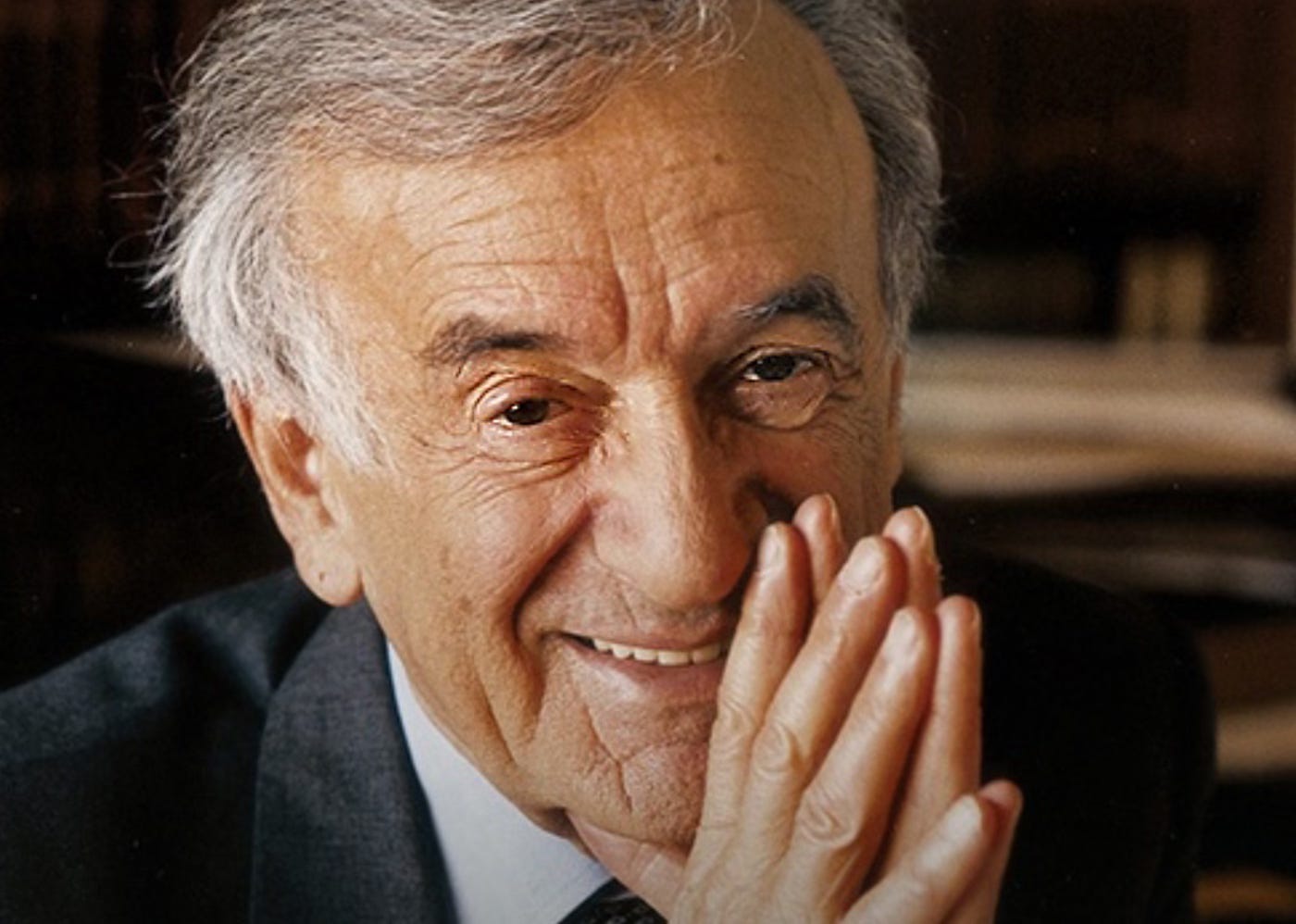
If Elie Weisel had not existed, the world would have had to invent him.
We needed him not only for his pivotal role in the public’s remembrance and acknowledgement of the Holocaust, but also for his broader role as the twentieth century’s literary conscience. He was, as the Nobel Committee described him in 1986, “one of the most important spiritual leaders and guides in an age when violence, repression, and racism continue to characterize the world.”
Eliezer Wiesel was born on September 30, 1928, at the midpoint between the two Great Wars, in a little city named Sighet, nestled in the Carpathian Mountains near the Romanian/Ukrainian border.
Sighet, pop. just over 25,000, was a quiet, culturally rich, picturesque little town with a history rooted in forestry and woodworking. It was a bucolic setting to grow up in, about the size and feel of the little college town of Amherst, Massachusetts, where I’m sitting right now in a coffee shop, writing these words.
For the Wiesels, that idyll was shattered in the spring of 1944 when Nazi troops marched in and took over. The entire family, along with roughly half the city’s population, was rounded up and deported to the camps. Within days, the 15-year-old was standing with his family in front of Josef Mengele at Auschwitz, watching as the man decided who would live and who would die.
Of the 1.3 million souls deported to the Auschwitz-Birkenau complex, some 1.1 million were murdered immediately upon their arrival.
The Wiesel family’s fate was split down the middle: Elie and his two elder sisters survived; their father, mother, and youngest sister did not.
Elie spent the next year in the camps, first Auschwitz, then Buchenwald, a place whose charming name (“forest of beech trees”) belied its purpose.
Upon the camp’s liberation in April 1945 (Note: Ana’s father was one of the American servicemen who was there that day to open Buchenwald!), Wiesel was relocated to an orphanage in Normandy, where he taught himself French. Within a few years the boy had made his way to Paris, where he studied literature, philosophy, and psychology at the Sorbonne. He left school after a few years to work as a journalist for French and Israeli newspapers; by the mid-1950s he had moved to New York to cover the United Nations.
Yet throughout that decade of post-war journalism, he did not write about his own direct experience of what was slowly coming to be known as the Holocaust.
In this silence, he was far from alone.
For nearly two decades after the war ended, hardly a soul spoke out publicly about what had happened in places like Auschwitz-Birkenau, Treblinka, Madjanek, and Dachau. It was as if the sheer enormity of the horror had stunned the world into mute denial.
Wiesel’s was one of the first voices to emerge from that self-imposed blackout.
In 1956 he wrote a sprawling, 800-page memoir in Yiddish, Un di velt hot geshvign (“And the World Remained Silent”). Two years later, at the urging of a friend, the French poet and novelist François Mauriac, Wiesel published a greatly condensed French translation under the title La Nuit.
It took more than a year to find an American publisher. Finally Hill & Wang (today a division of Farrar, Straus, and Giroux) offered an advance of $100 and brought out a slim volume entitled simply Night.
Wiesel’s riveting prose and uncompromising voice stunned those few early readers who pored through its 116 pages:
“Never shall I forget that night, the first night in camp, which has turned my life into one long night, seven times cursed and seven times sealed. Never shall I forget that smoke. Never shall I forget the little faces of the children, whose bodies I saw turned into wreaths of smoke beneath a silent blue sky. Never shall I forget those flames which consumed my faith forever. Never shall I forget the nocturnal silence which deprived me, for all eternity, of the desire to live. Never shall I forget those moments which murdered my God and my soul and turned my dreams to dust. Never shall I forget these things, even if I am condemned to live as long as God himself. Never.”
Night was well reviewed, yet it sold barely a thousand copies in its first 18 months. Nobody wanted to talk about the Holocaust.
At least, not yet.
Earlier that same year of Night’s publication, however, on May 11, 1960, news broke of the capture in Argentina of Adolf Eichmann, one of the principal architects of what had been termed, with that chilling detachment only a sociopathic bureaucracy could wield, “the final solution.”
The national mood began to shift. The press took notice of Eichmann’s trial in Israel. Public comprehension of the scope of Hitler’s horrors began to dawn.
Night went on to sell more than 10 million copies, and Wiesel became the world’s leading voice of remembrance, conscience, and moral outrage.
The author of Night kept writing, producing some 60 books, including both novels and nonfiction works. Yet it was as a speaker and public figure that he had the most impact, speaking out against persecution and systemic violence at every turn, plying his essential messages on the importance of remembrance and the moral imperative of action in the face of indifference.
He condemned the burnings of black churches in the United States, decried apartheid in South Africa, pled the case of tortured political prisoners in Latin America. He denounced the massacres in Bosnia in the mid-1990s and reportedly helped persuade Bill Clinton to intervene. He condemned the slaughters in Cambodia, Rwanda, and Sudan.
During his career he received over 20 honorary doctorates and dozens of awards, including both a Grand Cross and Grand Officer of the French Legion of Honor; a US Congressional Gold Medal and Presidential Medal of Freedom, the two highest civilian awards in the US; a Gold Plate Award of the American Academy of Achievement presented in person by Rosa Parks; and in 1986, a Nobel Peace Prize.
In his 1986 acceptance speech before the Nobel Committee in Norway, he said:
“I swore never to be silent whenever, wherever human beings endure suffering and humiliation. We must take sides. Neutrality helps the oppressor, never the victim. Silence encourages the tormentor, never the tormented.”
He recalled, on their cattle-car trek to Auschwitz, turning to his father and asking:
“Can this be true? This is the twentieth century, not the Middle Ages. Who would allow such crimes to be committed? How could the world remain silent?”
He concluded his speech with these words:
“As long as one dissident is in prison, our freedom will not be true. As long as one child is hungry, our lives will be filled with anguish and shame. What all these victims need above all is to know that they are not alone; that we are not forgetting them, that when their voices are stifled we shall lend them ours, that while their freedom depends on ours, the quality of our freedom depends on theirs.”
As Joseph Berger wrote in Wiesel’s obituary in the New York Times:
“There may have been better chroniclers who evoked the hellish minutiae of the German death machine. There were arguably more illuminating philosophers. But no single figure was able to combine Mr. Wiesel’s moral urgency with his magnetism, which emanated from his deeply lined face and eyes as unrelievable melancholy.”
Sara J. Bloomfield, director of the Holocaust Museum in Washington, D.C., which Wiesel played a pivotal role in creating, said it succinctly:
“He was a singular moral voice.”
Though he was not without his critics, especially among those who felt that Wiesel unnecessarily held back from criticizing the actions of Israel in its ongoing conflicts with its neighbors, particularly in Lebanon and Gaza.
In a lengthy 1984 interview in The Paris Review he acknowledged the apparent contradictions, adding:
“I don’t pretend to be able to solve the paradoxes in me. There are many paradoxes which are part of my life. I am absolutely a pacifist, against violence, surely against killing, and yet I am totally for Israel.”
Ironically, the award-winning author remained ever skeptical of the capacity of books and writing to do full justice to the truths they sought to describe. This virtuoso of the written word often wrote about the inadequacy of language, claiming that on the one hand, the scope and full realities of the Holocaust defied verbal expression, and yet, on the other, that silence was unacceptable — a paradox he called his “dialectical conflict.”
As he writes in the memoir One Generation After:
“[In Auschwitz] a miserable crust of moldy bread came to contain more truth, more eternity than all the pages of all the books put together.”
Meeting him in person, people were often surprised at his gentle manner. Wiesel was soft-spoken, meticulously attentive, carrying himself with an old-world gentlemanliness that seemed almost anachronistic. He never raised his voice, yet when he spoke, everyone in proximity leaned forward to catch every word. (My own father, the professor and choral conductor German-Jewish immigrant, was often described in precisely these same terms.)
Contrary to his austere reputation, close friends remarked on his warmth and affection, and especially his dry, even mischievous sense of humor. His wife Marion reported that he could be unexpectedly playful. And his students at Boston University, where he taught for four decades, described him more as a moral guide than a lecturer, gently prodding them to ask bigger questions.
Yet in his presence, one never missed for a split second the depth of his sorrow, nor the weight of his moral authority. As Rabbi Jonathan Sacks observed:
“He was a deeply gentle man, but there was something in him that made you sit up straighter.”
In 2002, Wiesel traveled to Romania to dedicate a museum in his hometown, Sighet, in the very house where he had grown up. Commenting on the ceremony, he remarked that he was stunned at how much it looked exactly as he remembered it, how nothing had changed — except for one thing: the Jewish population, roughly 13,000 at the start of 1944, had now been reduced to a total of 20.
Note: That is not a typo. In a total 2002 population of over 40,000, in this city that had once been a major European center of Jewish culture, there were now twenty Jews remaining. (As of today, that number has edged closer to 100.)
Wiesel continued to suffer nightmares throughout his life and spoke often of his struggle with despair and loss of faith. (One of his books is titled Four Hasidic Masters and Their Struggle Against Melancholy.) In that same Paris Review interview, he reported that as an adult, he lived every moment of every day on the edge of the abyss.
“There isn’t a day without my thinking of death or of looking into death … trying to understand what happened.”
And death, evidently, had not forgotten about him, either.
In 1956, while crossing a street in Midtown Manhattan, he was struck by a taxi and dragged down the road. The near-fatal accident left him comatose, with 48 fractured bones; he spent three months in a hospital and a year in a wheelchair. He fictionalized the event in his novel The Accident (also published as Day, part of the Night trilogy), which explores survivor’s guilt and the subconscious impulse to continue courting death.
In 2007, at age 78, he was assaulted and dragged out of an elevator by a 22-year-old man who dismissed the Holocaust as “the big lie” and wanted to force Wiesel to admit that he’d made it all up. This time, Wiesel was not physically hurt.
Nine years later, in 2016, he died peacefully from an illness, in his home in Manhattan, at age 87.
Two years later that same Romanian museum that had once upon a time been Wiesel’s childhood home was vandalized, spray-painted with graffiti in fluorescent pink that spelled out, among other messages, “public toilet” and “Nazi Jew lying in hell with Hitler.”
A suspect was arrested, but there is no public record of a conviction.
Recommended Reading
If you’ve never read any Weisel, here are some suggestions for where to dip your toe into the water:
Night (1956), his spare, devastating memoir of Auschwitz and Buchenwald, one of the seminal works of Holocaust literature.
Dawn (1961) and Day (1962), companion novels to Night, exploring the psychological and moral aftermath of survival.
The Gates of the Forest (1964), a more expansive novel of memory, identity, and faith after catastrophe.
Souls on Fire (1972), his passionate retelling of Hasidic masters, revealing the spiritual tradition that shaped him.
If you’d like to delve further into Wiesel’s work, here is a next-steps list that encompasses the far-reaching scope of his essays and other nonfiction writings:
One Generation After (1970), essays on memory, responsibility, and the moral demands placed on survivors.
Messengers of God (1976), reflections on biblical figures, illuminating Wiesel’s spiritual and interpretive voice.
Against Silence (1985), a wide-ranging collection of essays, speeches, and reflections across decades.
Nobel Peace Prize Acceptance Speech (1986), a brief, powerful statement of remembrance and moral urgency.
Let me know if you read any of these and fall in love!
Is there a book in you, waiting to be written? A story you’ve been wanting to tell, an expertise you need to share? Consider joining our community of writers in my one-year coaching program, Writing Mastery Mentorship.
John, you touched my heart with this one. God bless. Pastor Wesley Post
Beautifully done, John…