
On chasing your dreams
SUE GRAFTON | “If you want to do it, you better get down to it. There is no margin for neglecting your own dreams.”
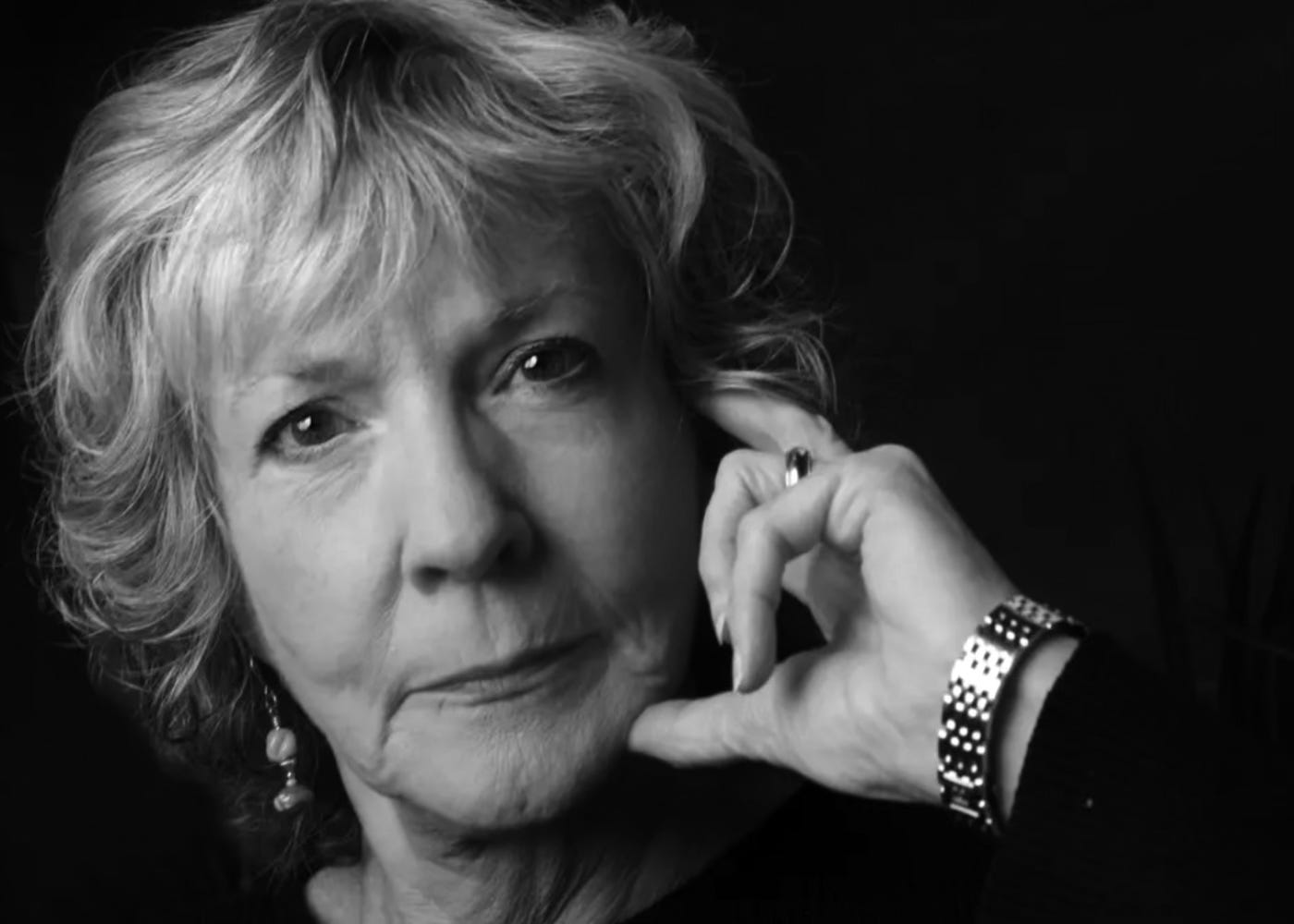
Dear Faithful Reader,
I was on a podcast this week, and it happened again. It nearly always does.
I was there to talk about my books, my coaching program, my career as a writer, you know, the stuff I’m doing now. But the host promptly zeroed in on the one thing he wanted to get to, above and beyond any other topic, the one thing that nearly every podcast host and interviewer asks me about at some point:
“So, when you were seventeen, you started your own high school?
How does THAT happen?!”
Yes: when I was seventeen, a group of friends and I started our own high school. We had absolutely no accreditation of any kind, yet our graduates went on to places like Yale and Harvard and state colleges across the country. How did that happen? It happened like this:
We decided to do it; then did it.
There are details, of course.
My parents graciously allowed me to drop out of school in my junior year, so I could spend that entire year working on the project. We figured out early on that we needed a grownup behind the wheel … interviewed a handful of amazing candidates, “hired” (the quote marks meaning there was no money involved, not at this stage) a fantastic director, a novelist and educator named Julian F. Thompson … and Julian and I worked all day every day for months on end to nail down everything that needed to happen … and come the next September we opened our doors in donated space in a great old building with some fifty kids, a full-time paid faculty of three, and a horde of volunteer teachers from our parent body.
But those are just details. The important part was the decision.
Which brings me to my friend Joe, who is a hero of mine.
Joe grew up in a small town in Western Massachusetts. (He and my wife went to grade school together.) After graduating college with a Phys Ed degree, Joe took a job at the YMCA, where he worked for 32 years until he retired. It was a good life.
But then he did something unusual.
In school, Joe had been a runner, and a good one. Not exactly famous, never turned pro, but he’d racked up quite a record: 255 races with 96 first-place finishes.
He ran in the Boston Marathon, competed in the very first New York City Marathon (where he took thirteenth place), and formed a close friendship with two of the sport’s legends, Bill Rodgers and Tom Fleming (they called themselves “the three amigos”).
And he decided to write a book about his experiences.
He spent months writing up chunks of memories and stories, organizing them as best he could. He knew he needed professional help to make it to this particular finish line.
He approached my wife, and we helped him organize it, fill in missing pieces, found him an editor and a guy who could manage the logistics of production and listing on Amazon. (This was in the days before I’d started the Writing Mastery Mentorship program.) I came up with a cover design (it’s not going to win any awards, but it works). Bill Rodgers wrote the foreword. And boom, the book was done. (It’s called On the Run: Friendships and Finish Lines.)
And then Joe went to work: hauling it around town, placing it in stores, giving talks, doing book signings, putting on a Zoom launch for a huge group of friends.
For years now, he’s been having an absolute ball, being an author, promoting his book, gaining readers, telling his stories. He did what it takes to not simply write and publish a book, but do a quality, professional job of it, and then actually launch it.
And in the process, he wrote an entirely new chapter of his life.
That’s why he’s a hero of mine. He understood, as Sue Grafton put it in a 2007 interview with Bookthink, that “there is no margin for neglecting your own dreams.”
Many years ago I wrote a piece called “The Eighth Day of the Week,” that went something like this:
“Someday, when I have the time, I’m going to…”
“Someday, when I have the money, I’m going to…”Have you every said that? I know I have. Here’s the thing that’s so insidious about that: It’s easy to squeeze some sense of satisfaction out of imagining that we’re doing this thing we want to do, playing a movie of it in our minds, picturing it happening in some removed, nonspecific “future,” untouched by any of the pragmatic demands of action.
Someday I’m gonna do XYZ, yeah, someday…
But that’s not a dream: that’s a fantasy.
If it’s a true dream, something to which you genuinely aspire, then you’re doing something to ground it in reality. You’re putting a date on a calendar. You’re picking up the phone and making a call. You’re working out what you need to do next, and next, and next. No matter how far off in the future that thing may realistically be, you’re taking at the least some whisper of action right now to put the wheels in motion.
Because if you’re not, that dream will fade irrecoverably into the world of someday.
And Someday is the eighth day of the week.
The day that never comes.
It may be that this thing you’ve always wanted to do won’t be possible for months, or years. It may be that all sorts of things will have to happen first, and that taking the first step, and the second, will mean you’re putting something into motion that will take all sorts of trial and error, disappointments and setbacks, before it becomes manifestly real.
It may be that you’ll need to enroll help (as Joe did), and that there’ll be challenges involved that right now you have no clue about (as Joe didn’t).
But it all starts with a decision and that first action.
Back in 2008, shortly after The Go-Giver came out, the bestselling personal finance author David Bach got in touch with me to talk about writing a parable together, based on his trademark “latte factor” concept. We had talks, spit-balled a few ideas, started working out a contract … and then life got in the way.
The economic crash happened. David suddenly had other, more urgent projects to write. I got involved in other books.
The dream faded into the realm of “someday.”
Then one evening, nearly a decade later, David was having dinner in New York City with Paulo Coelho (yes, that Paulo Coelho). They talked for hours. At one point David mentioned how he’d had this idea for a parable, but it had never quite come together—
And Paulo suddenly exclaimed, with fire in his eyes, “Then, David, you have to do it!”
The next day, David picked up the phone.
We wrote the book, and it hit the New York Times bestseller list … thanks to the author of The Alchemistpointing out what Sue Grafton could have told us too:
“If you want to do it, you better get down to it.”
So my question for you:
What is it that you’ve always wanted to do “someday”? (If you trust me enough to share this, REPLY HERE — I would love to read your answer!)
And by the way, a dream doesn’t have to be some dramatic thing, like starting a school, or a big deal, like writing and launching a book. It can be something simple.
My father used to travel for musicology conferences. He had a knack for persuading the organizations he was part of to hold their meetings in cities that, you know, quite by coincidence, just happened to be located near where one of his three boys lived. So we all got to see him regularly.
But we didn’t see each other that often, and my mom didn’t love traveling, so we saw her only rarely.
We used to say, wouldn’t it be awesome if we could all find a time to get together for a visit? Like, a family reunion. But it never happened. We were all busy with our lives.
Until one day, out of the blue, I decided to do it.
You have to understand: I was the least likely son to do this. I was the one who always forgot birthdays, the one who wasn’t great about staying in touch. But something made me suddenly pick up the phone.
A few months later we all assembled, from different parts of the country, and spent an incredible day together at my parents’ home in upstate New York, went on a boat tour of Canandaigua Lake, had some fabulous meals together, talked and talked and talked. Our kids got to see each other.
A beautiful time was had by all. And then we all went home.
Shortly thereafter we learned that my mom had throat cancer.
A year later, she was gone.
The fuller version of that Sue Grafton quote that tops this month’s letter includes an added sentence in the middle. It goes like this:
“If you want to do it, you better get down to it. We don’t know how much time we have on this earth. There is no margin for neglecting your own dreams.”
I am so grateful that when I felt the impulse to pick up the phone that day, I didn’t simply shrug and say, “We should really do that someday…”
My October wish for you:
That you take a little time every day to ask yourself, “If money were no object, and I had all the time in the world, what would I be doing right now?” — and then find some way to do that, even a little, even a whisper of that dreamed-of thing, right now, today.

About the writer
My name is Kinsey Millhone. I’m a private investigator, licensed by the state of California. I’m thirty-two years old, twice divorced, no kids. The day before yesterday I killed someone and the fact weighs heavily on my mind.
With these 38 words, on April 15, 1982, the world was introduced to something new: a hard-boiled Southern California private eye who took on all manner of crimes and criminals with no resources beyond guts, wits, and plenty of shoe leather … and was not a macho, fist-wielding man.
In fact, not a man at all.
A Is for Alibi, the book that opens with the paragraph above, received lukewarm reviews — Kirkus Reviewscalled it a “shakily plotted but otherwise terrific start” and a New York Times reviewer sniffed, “This first book is competent enough, but not particularly original” — and it sold less than 5,000 copies.
But Sue Grafton, Kinsey’s creator, wasn’t finished yet.
A Is for Alibi was followed in 1985 by B Is for Burglary, a year later by C Is for Corpse, then D Is for Deadbeat (1987) and E Is for Evidence (1988), none of them setting the world on fire but all of them gaining a steady following.
By the time she got to the sixth letter of the alphabet in 1989 (F Is for Fugitive), Grafton hit the New York Times bestseller list, entering the paperback list at number 10.
By 1995, with L Is for Lawless, she was #1.
All in all, the Kinsey Millhone novels have spent an aggregate of 400 weeks on the New York Times bestseller list, and Grafton’s work has won four Shamus awards, five Anthonys, one Macavity, an Edgar Grand Master, a Bouchercon Lifetime Achievement award, an Agatha Lifetime Achievement award, a Shamus Lifetime Achievement award, the Ross MacDonald Literary Award, and a string of other wins and nominations.
Not too shabby for a “shaky start.”
Full disclosure: Sue Grafton is one of my favorite novelists.
I adore her personality, which shines through her creation Kinsey: cheeky, tough, thoughtful, sensitive, and doggedly independent. She cuts her own hair with fingernail scissors, drives a beat-up Volkswagen, and her go-to favorite meal is a peanut butter and pickle sandwich.
She makes the world a better place, in part because she solves crimes and takes down the bad guys, but mostly just by being herself.
Grafton often pointed out that Kinsey was her own alter ego:
Kinsey is my unlived life … the person I might have been if I hadn’t married early and had children.
I also love Grafton because she reminds me of my own mother: smart, quick with a wisecrack, irreverent, resourceful. (I’m writing this on my mother’s October birthday. Happy birthday, Mom!)
As a writer, there’s one more thing I adore about Sue Grafton: her work ethic. But we’ll come back to that in a minute or two.
Sue Taylor Grafton was born on April 24, 1940, in Louisville, Kentucky. Her mother, Vivian, was a school teacher, and that’s what Sue figured she’d end up doing. “Because that’s what women did,” she said. “You could be a nurse, a ballerina or a teacher.”
Fortunately for us, that’s not how it worked out, because Sue’s father, a municipal bond lawyer, had a passion for mystery novels, which he devoted himself to writing in his spare time.
Chip Grafton schooled his daughter in writing and editing, hoping for her to become a writer in his own footsteps. Yet although he published several novels himself, one of which even won an award, he never quite succeeded in breaking out. As Grafton later told Bookthink:
“It was his desire, I believe, to give up the law in order to publish and write mystery fiction, but he couldn’t make a living at it. In the end, he gave up writing to support me and my sister. His intention was to go back to it after he retired, but he didn’t live that long…”
And that’s where this month’s quote comes from, because in the next breath she added this thought:
“So I learned from that, too, the lesson being, if you want to do it, you better get down to it. We don’t know how much time we have on this earth. There is no margin for neglecting your own dreams.”
Sue’s parents were both alcoholics, her childhood in many ways a dark one, as she revealed in her 2013 book Kinsey and Me. Sue often had to fend for herself. (“People talk about dysfunctional families,” as Kinsey Millhone says in F Is for Fugitive. “I’ve never seen any other kind.”)
In 1960 Grafton’s mother, a lifelong heavy smoker, underwent surgery for esophageal cancer; upon returning home, she killed herself. Sue was barely 20.
Two years later, with an undergrad degree in English literature from the University of Louisville under her belt, she moved to California, where she worked odd jobs — hospital admissions clerk, medical secretary, cashier — while writing in her spare time.
Like her father, she struggled but couldn’t quite get traction in the marketplace. She published a few novels — Keziah Dane (1961) drew positive reviews, and The Lolly-Madonna War (1969) was made into a movie that, despite its star power, more or less flopped — and wrote five other novels, none published, all of which she later destroyed. (“Those unpublished books were how I taught myself to write.”)
She spent the next 15 years writing for the Hollywood machine, mostly teleplays for made-for-TV movies, even created a series, Nurse, that ran for two seasons on CBS.
She learned a ton about the craft but hated the “writing by committee” dynamics of the TV writing room and detested the politics of Hollywood decision-making.
She yearned to work alone.
Then, around the time Nurse was running on CBS, she tried her hand at a mystery, starring a female protagonist, modeled on herself.
“I had never written a mystery before, although my father had written and published three mysteries in his lifetime. So for me it was just fun! I had nothing to lose; I had no reputation. … You know we often take things on that we think we can’t pull off.”
Inspired by crime writers who wrote series with strings of related titles — John D. MacDonald, whose Travis McGee novels are each based on a different color, and Harry Kemelman’s Rabbi Small series, whose titles included the days of the week — she was especially taken with Edward Gorey’s macabre 1963 book The Gashlycrumb Tinies, in which 26 children each meet a grisly fate:
A is for Amy, who fell down the stairs.
B is for Basil, eaten by bears.
C is for Clara, who wasted away.
D is for Desmond thrown out of a sleigh…
And so on. As Grafton later told the New York Times:
“I was smitten with all those little Victorian children being dispatched in various ways. Edward Gorey was deliciously bent.”
And there was one last source of inspiration that helped fuel Kinsey’s creation: Grafton had just gone through a bitter divorce, complete with lengthy and brutal custody battle, and it gave rise to some nasty fantasies.
Just as a down-sized TV producer named Jim Grant (aka Lee Child) would later fantasize about all the grisly ways of murdering the bosses who’d fired him (which led to the creation of Jack Reacher), Grafton entertained herself by contemplating all manner of gruesome comeuppances for her ex.
“I used to lie awake at night and think of ways to kill the man. However, because I am such a law-abiding little bun, I knew I’d get caught at it. … I am the sort of person who does not even turn a library book in late. If I get a parking ticket, I know they’re discussing me down at the police station. … I launched an entire career for myself out of mere homicidal rage.”
She submitted the first 65 pages of A is for Alibi to the New York publisher Henry Holt, where an editor named Marian Wood, who’d never edited a mystery before, was intrigued by the character’s voice. Holt paid Grafton an advance of $10,000.
And Kinsey was born.
Grafton was not the first female creator of a series starring a female private eye. Just three months before Alibi came out, the Chicago-based author Sara Paretsky published the debut novel of her V.I. Warshawki series, and five years earlier Marcia Muller had published the first of her long-running Sharon McCone series. (The name “Kinsey Millhone” itself is a homonymic homage to Muller’s heroine.)
The three of these pioneers — Grafton, Paretsky, and Muller — paved the way for later generations of women novelists who wrote crime fiction with female protagonists, including Patricia Cornwell (Kay Scarpetta), Janet Evanovich (Stephanie Plum), and Kathy Reichs (Temperance Brennan).
For Grafton, writing a female private eye meant creating a character who was willing to deal openly with the human and emotional impact of violent crime. As she said in a 1985 interview with the New York Times:
“Most of the hard-boiled male detectives go through murder and mayhem, and it has absolutely no impact on their personalities. I find it more interesting to see what the constant exposure to violence and death really does to a human being.”
It also meant a ton of research to maintain a consistent level of authenticity. Over the years Grafton learned to shoot a gun (she proved to be a crack shot), took classes in self-defense and courses in law, studied ballistics, learned the ins and outs of burglary and auto theft, visited two morgues, and did nighttime ride-alongs in police cars.
As she once told NPR’s Terry Gross:
“Often, I find that I look at the world through her eyes. And I think to myself, ‘Kinsey Millhone would not be intimidated!’ — and therefore, whether it scares me or not, I had better straighten up my act.”
Some series novelists seem to grow stale and struggle to maintain the originality, impact, and power of their early books. For Grafton, the arc bends the other way: the books seem to get not only better and better, but also to go deeper. As book critic Maureen Corrigan said in an NPR tribute after the author’s death:
As the series went on, her plots grew more intricate, increasingly haunted by the past and its crimes.
By the time she reached S Is for Silence, Grafton began experimenting with multiple perspectives and time shifts, and she continued to play with these innovations for every book thereafter (except for X, which isn’t called “X Is for…” anything, but just X).
In T Is for Trespass, we experience entire chapters through the eyes of Solana Rojas, a monstrous sociopath whose utter devotion to her son defies the easy tendency to oversimplify the nature of psychopaths.
This was new territory. I still remember reading that one when it first came out; every page gave me the chills. (T is my personal favorite of the Kinsey books.)
The author reported that she’d produced perhaps a thousand pages of drafts for Trespass, abandoning half a dozen different storylines before she found the one that worked. While in the midst of writing the next one, U Is for Undertow, she told Bookthink:
“I find it is getting harder. T has been a bitch. It has been the toughest book I’ve ever written. Finally, I am nailing it. If U is this hard, I’m going to have to be institutionalized!”
I love that: “Finally, I am nailing it.”
Says the trailblazing, wildly successful #1 New York Times bestselling novelist … after finishing her twentiethbook.
See what I mean about work ethic?
Grafton talked about this, too. Again, from her Bookthink interview:
“I worry that people don’t have the tenacity, the patience, and the humility to learn to write well. A lot of aspiring writers don’t understand how much work is required. [They] imagine that you just write a book and then magically, if you know the right people, you get it published. Knowing the right people has nothing to do with it.
“Somebody’ll write one book, and they’re asking me who my agent and my editor are, and I’m thinking, Don’t you worry, sweetheart, you’re not any good yet. Give yourself time to get better.”
The last Kinsey Millhone book, Y Is for Yesterday, came out in 2016. For years Grafton had been planning to title the final book in the series Z Is for Zero — but cancer cut her life short in 2017 before she even got to start it.
As her daughter wrote on the author’s website when announcing her passing:
“As far as we in the family are concerned, the alphabet now ends at Y.”
Despite the offers (obscenely lucrative, no doubt), Grafton refused to allow Kinsey to be adapted to the screen. She famously told her children that if they ever sold the film rights to her books after her death, she would come back from the grave to haunt them.
“I would never let those clowns get their hands on my work. They’d ruin it for everyone. … I liken it to selling your children into white slavery.”
Be that as it may, in 2021 her family, citing the marked improvement in the quality of television drama writing and production, sold exclusive rights to A+E Studios to adapt the entire mystery series for television.
There have been no official reports of any ghost sightings; still, as of today — four years to the day since the A+E announcement — production seems to be mysteriously stalled.
Recommended Reading
If you’ve never read any Grafton, here are some suggestions for where to dip your toe into the water:
A is for Alibi (1982), the first of her beloved Kinsey Millhone mysteries.
T Is for Trespass (2007), a chilling portrait of a psychopath, one of my personal Grafton favorites.
Kinsey and Me (2013), a riveting, haunting collection of stories about Kinsey’s origins and Grafton’s own dark past.
Let me know if you read any of these and fall in love!
Is there a book in you, waiting to be written? A story you’ve been wanting to tell, an expertise you need to share? Consider joining our community of writers in my one-year coaching program, Writing Mastery Mentorship.