
On love
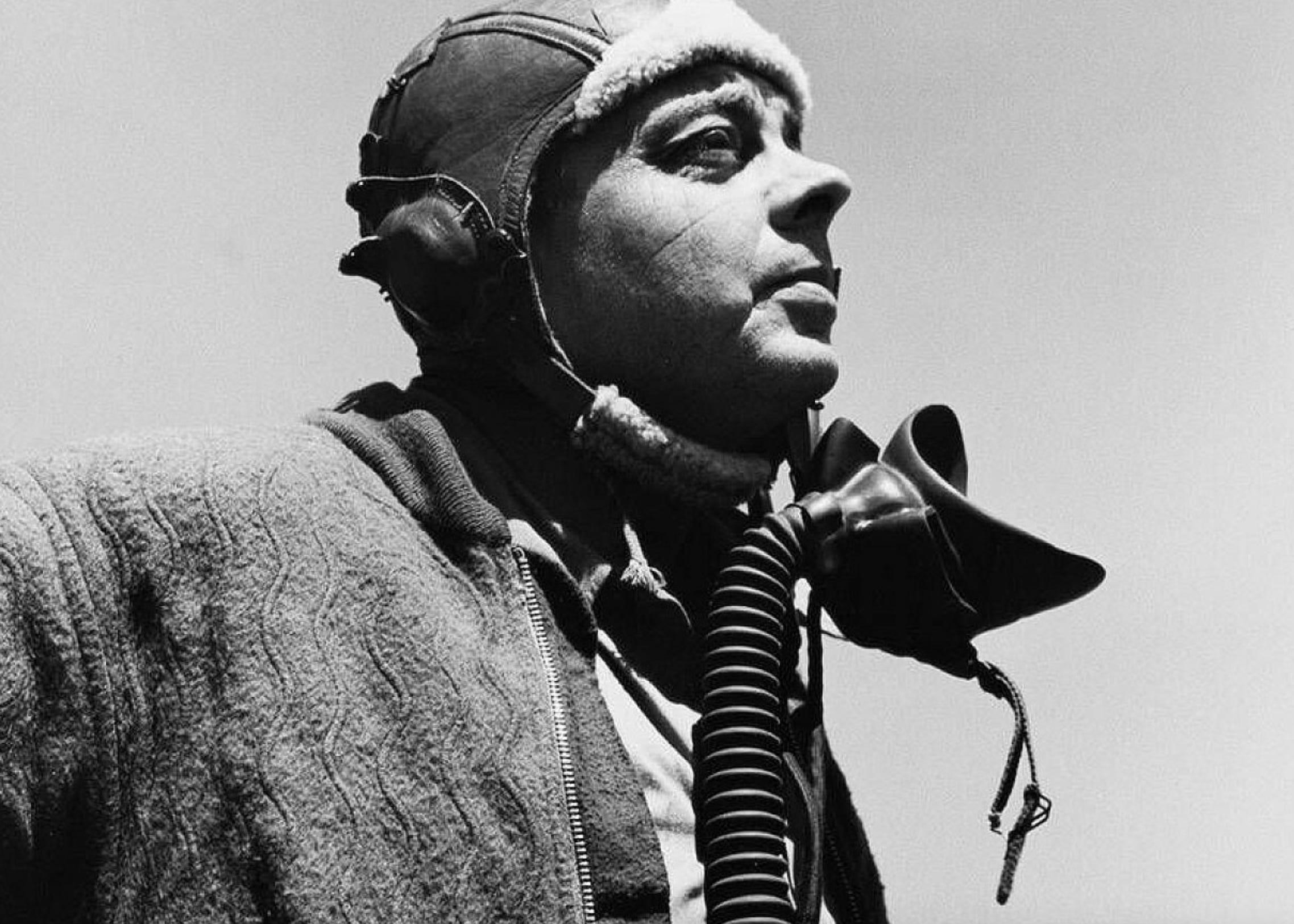
ANTOINE de SAINT-EXUPÉRY | “When you look up at the stars at night, since I’ll be living on one of them, since I’ll be laughing on one of them, for you it will be as if all the stars are laughing.”
Dear Faithful Reader,
I’m working on a new parable that opens with a man named Ray waking up in bed to find that he is having a fatal heart attack.
The kind of thing that can ruin your whole day, right?
Spoiler alert: it’s not actually fatal. In fact, it’s not even an actual heart attack. (It’s a panic attack.) But it sure gets Ray thinking about mortality.
It’s got me thinking about mortality, too. Perhaps in part because I’m drafting this letter on Memorial Day. Perhaps in part because I recently heard a snippet of the old Gene Raskin* song, Those Were the Days.
“Those were the days, my friend,
we thought they’d never end…”
But of course, they do. Days always end. Moments end. Our lives end.
Or, wait … do they? Our lives, I mean.
The French composer Maurice Ravel died in 1937, but Le Tombeau de Couperin is playing in my ear right now. The author and aviator Antoine de Saint-Exupéry was shot down over the Mediterranean by German forces in 1944, yet he’s alive and well in the quote at the top of this email.
My father, Alfred Mann, died in 2006 at the age of 89 — but I saw him early this morning in a dream, as real as your fingertips, and laughed over a few jokes with him.
Thinking about mortality has got me thinking about immortality, too.
Those Were the Days is an ode to nostalgia and regret (“Then the busy years went rushing by / We lost our starry notions on the way…”). As if to say, Look what we’ve lost.
Looked at from the other side, though, it is also a tribute to the durability of good times. (“Oh, my friend, we’re older but no wiser / For in our hearts, the dreams are still the same.”) As if to say, We never lost any of it.
When we’re having a glorious moment, enjoying whatever is happening right now in a full and whole way, we say we’re “having the time of our lives.”
I think what we mean by that phrase is that all the joy, that all the richness and meaning of our lives boils down to this, what we’re experiencing right now. That past and future, regrets and anxieties, all dissolve into the momentous moment.
I think what we really mean is not having the time of our lives, but having the complete cessation of time in our lives.
I think what we really mean is, touching the eternity of our lives.
On Memorial Day we often speak about the soldiers who gave their lives for the sake of something bigger than themselves. But that bigger something is not necessarily “America,” or “democracy,” or “freedom,” or even “the folks back home.”
Ask the soldier in the heat of the moment what they are fighting for, and their answer will very likely be something like this:
“To save the life of the guy next to me.”
When Viktor Frankl wrote in Man’s Search for Meaning about what he called “the self-transcendence of human existence,” he went on to say:
“Being human always points, and is directed, to something, or someone, other than oneself — be it a meaning to fulfill or another human being to encounter [emphasis added].”
There is something in loving a cause or another human being in such a way that in that moment, we lose ourselves to that love, that touches eternity.
Perhaps “find meaning” is another way of saying “touch eternity.”
So my question for you:
What are those moments in your life when you lose yourself and touch eternity? (If you trust me enough to share this, REPLY HERE — I would love to read your answer!)
This month’s quote comes from the final pages of that magnificently timeless dream of a story, The Little Prince, which concludes with what is perhaps the greatest farewell scene ever written.
In that scene, the little prince tells the aviator that he is leaving, by which we know he means he is dying, but at the same time (in that mysterious way of dreams) we also know he means he is going back to the tiny asteroid he came from, and he says, “It’s too small, where I live, for me to show you where my star is.”
And then he says, “When you look up at the sky at night, since I’ll be living on one of them, since I’ll be laughing on one of them, for you it will be as if all the stars are laughing.”
This farewell passage runs on for pages, and tucked away somewhere in the middle of it the little prince lands this statement:
“The important thing is what cannot be seen.”
That one sentence contains the pulsing heart of the whole book. Saint-Exupéry’s little parable of love shows me something about eternity that helps me understand it a little better:
You cannot see eternity — but you can touch it.
I don’t miss Maurice Ravel or Antoine Saint-Exupéry, but of course, I didn’t know these men and love them personally.
I do miss my father, very much so … that is, until I’m asleep and dreaming, and then I don’t miss him at all, because here he is.
For me, in those moments, it is as if all the stars are laughing.
My June wish for you:
That you take a little time every day to ask yourself, “If I knew that I had just one month left alive on earth, or just one week, or just one day, what would I do right now?” … and then do that very thing.

* When I say “the old Gene Raskin song,” I should really say, “the old Konstantin Podrevsky/Boris Fomin/Gene Raskin/Mary Hopkin/Paul McCartney song,” because Those Were the Days was originally written by a Russian composer named Boris Ivanovich Fomin, with lyrics by his compatriot, the poet Konstantin Podrevsky, later reset with English lyrics (which were not translations of the original Russian but entirely new) by an American playwright and architecture professor named Eugene Raskin, and made famous as recorded at Abbey Road Studios in 1968 by Welsh singer Mary Hopkin and produced by Paul McCartney, when it became a #1 single on the UK charts, a #1 hit in Canada and #1 in the very first edition of the French National Hit Parade, and reached #2 on the US hit parade, just behind Hey Jude …
… living proof that a good song, like a good life, never ends.
About the writer
Antoine Marie Jean-Baptiste Roger, vicomte de Saint-Exupéry was born in central France in June 1900, into a family of minor nobility, Although Saint-Exupéry himself disliked the “viscount” the title and never used it. (The “Exupéry” refers back to Saint Exuperius, the 5th-century first bishop of Bayeux, a little town a few miles in from the Normandy coast.) His father, an executive for an insurance company, died when Antoine was just three years old, and the family’s fortunes never recovered.
Antoine and his siblings ran rather wild throughout their childhood, and Antoine himself, as acquaintances later in his life observed, never really grew up.
His mother, Marie, was utterly devoted to her five children; their various aunts and uncles, not so much, and these older disapproving relatives’ attempts to impose discipline on the children left a lasting distaste in Antoine’s memories, as reflected in the repeated indictments of “grown-ups” found in Le Petit Prince:
“I have lived a great deal among grown-ups. I have seen them up close. That has not much improved my opinion.”
His younger brother François, to whom he was devoted (Antoine called him his closest confidant), died at age 15 of rheumatic fever. Antoine, then 17, attended to François by his death bed; he later wrote that his brother…
“remained motionless for an instant. He did not cry out. He fell as gently as a young tree falls…”
… an image strikingly echoed in the conclusion of Le Petit Prince.
“Saint Ex,” as his friends called him, made his first solo flight at the age of 11 in a plane he fashioned himself out of a bicycle, and immediately decided his would be the life of an aviator. As he later wrote to his mother:
“If you only knew the irresistible thirst I have to fly.”
Ten years later, at 21, he joined the French Air Force and got his pilot’s license, and thereafter joined the legendary French air mail service that became known as Aéropostale.
In those interbellum days France ruled the skies; even before WWI, France held more flying licenses than the United States, England, and Germany combined. France was also then the world’s second-largest colonial power (after Britain), and Saint Ex found himself stationed at such distant posts as Cape Juby in the Western Sahara (one of the most remote airstrips in the world) and Patagonia, at the southern tip of South America.
Some of these early planes were incredibly primitive contraptions, hopelessly frail by modern standards: wooden propeller, no radio, no suspension, no sophisticated instruments, and no brakes. Pilots navigated by crude maps (approximations more than blueprints) and vague landmarks. Crashes were relatively commonplace affairs; Saint Ex himself walked away from at least four plane wrecks.
During the 1920s and 30s he flew his planes through the most hostile elements imaginable, occasionally crashing them and frequently being called to rescue similarly crashed colleagues.
During this time he developed the habit of reading and even writing during hours-long solo flights at night; on one flight, to the horror of his colleagues on the ground, he circled the airfield for an hour before landing so he could finish the novel he was reading.
Saint Ex chronicled these experiences in his writings from those years, including the novels Southern Mail(1929) and Night Flight (1931) and the memoir Wind, Sand and Stars (1939).
The language in these works is gorgeous and vivid, filling his semi-autobiographical stories with real descriptions in pulse-pounding detail. For example, this passage from Night Flight:
“With each new plunge the engine began vibrating so violently that the entire plane was seized with angry trembling. Fabien needed all his strength to control it. His head ducked far down inside the cockpit, he kept his eyes glued to the artificial horizon; for outside he could no longer distinguish earth from sky, lost in a welter of primeval darkness. … At this very moment the storm opened above his head and through a rift, like mortal bait glittering through the meshes of a net, he spied several stars. … At a single bound, as it emerged, the plane had attained a calm that seemed wondrous. There was not a wave to rock him, and like a sail-boat passing the jetty he was entering sheltered waters. … Beneath him, nine thousand feet deep, the storm formed another world, shot through with gusts and cloudbursts and lightning flashes, but towards the stars it turned a surface of snowy crystal.”
Saint Ex’s reputation as a writer was already well established with Southern Mail and his earlier works; with Night Flight it soared. The book was an instant hit with the public, won the Prix Femina, France’s prestigious literary award, and was adapted as the 1933 MGM/David O. Selznick/John Barrymore film of the same name.
The famed House of Guerlain cosmetics and perfume giant released an expensive scent called Vol de Nuit, sold in a bottle branded with the bold image of an airplane propeller. (You can still buy it today, at $130 for 2.35 ounces; according to Guerlain’s website, “It is worn by demanding and very charismatic women.”)
Despite his success, Saint Ex was never wealthy; he was, according to his biographer Stacy Schiff, “hopelessly irresponsible” with money and perpetually hovering on the brink of broke.
He was also heedless of any hint of political correctness and fiercely independent.
His books were banned in France by the collaborationist Vichy government (he was attacked as a “defender of Jews” and for his criticism of Hitler), but he was no big fan of Charles de Gaulle’s either, fearing the wartime general might be inclined to become a peacetime dictator. In turn, de Gaulle denounced his work, resulting in the ironic situation of his books being banned by both sides of the conflict, occupied France and the Free French colonies, at the same time!
On December 31, 1940, Saint Ex arrived in New York City with several missions in mind. He was there to claim his 1939 National Book Award for Wind, Sand and Stars (the book had already sold a quarter of a million copies), and he also hoped to persuade the U.S. government, which had so far remained on the sidelines, to enter the conflict against the Axis powers as soon as possible.
The trip was a disappointment; for much of his two years in North America, Saint Ex was miserable. His years of injuries and bodily abuse were taking their toll; he refused to learn English; he grew depressed and began drinking more heavily. According to Schiff, in a later account in the New York Times:
He was not enamored of the United States or of the pace of life in New York, in large part because it seemed to him that a country capable of designing a state-of-the-art washing machine might also apply itself to saving France. Reminded … that New York represented only part of America, Saint-Exupery responded, “Yes, but the heart of the country is here, and the heart is hard.”
Yet there was at least one bright light during that time.
In the spring of 1942, the wife of one of his publishers persuaded Saint Ex to work on a children’s book, in part to distract him from his woes and also in hopes of competing with the wildly popular new P.L. Travers series about a magical British nanny called Mary Poppins.
For years, the aviator had been doodling a little figure in the margins of his letters and manuscripts, even on restaurant tablecloths.
Perhaps that little figure might come to life?
The writer took himself down to a drugstore on Eighth Avenue, bought himself a set of watercolors, and got to work. By that October the manuscript was finished; early the next spring Le Petit Prince was published in the US in both French and English editions. (It would not appear in France till well after the war.)
People were not sure at first exactly how to take this new book. Here’s how its first review from the pages of the New York Times began:
Exupéry’s new book is a very different one from his Night Flight, Wind, Sand and Stars, or Flight to Arras…
That’s for sure. The story, which the Times vaguely identifies as “a parable for grown people in the guise of a simply story for children” and “a lovely story in itself which covers a poetic, yearning philosophy,” was something no one had quite seen before.
Some found it unpalatably infantile; others, indescribably profound.
And it’s not hard to see why. The Little Prince is at once charming and strange, dreamlike and emotionally intense, sad and uplifting, sweet and bittersweet — an ode to love and devotion and an indictment of the world’s small-mindedness, a meditation on loneliness and on the eternal durability of companionship.
No wonder that same early review remarked that it was “not the sort of fable that can be tacked down neatly at its four corners.” Saint Ex’s masterpiece may possibly be the most difficult to categorize of any children’s book ever written.
And one of the most popular, too.
Le Petit Prince is rife with autobiographical allusions — the little prince’s relationship with his rose echoes Saint Ex’s complicated marriage to his wife, Consuelo Gómez Carillo, who was both his eternal muse and constant nemesis; the fox in the story is an homage to a mistress; the little prince’s native asteroid, B-612, harkens back to one of the author’s earlier airplanes that bore the same number — and the entire narrative is loosely based on an actual experience of being downed in the Libyan desert in 1935, when he and his copilot had to trek through the sand for three days to find help.
But you don’t need to know any of that, nor anything else about the book’s background or layers of memoir and allegory that shimmer behind its prose, to delight in its magic. Regardless of what history you bring to it, the sheer poetry and poignancy of the book hits you right between the eyes and straight in the heart — and it’s been doing so for generation after generation of children ever since the 1940s.
Le Petit Prince has been translated into more than 250 languages and been cited as #2 of the world’s five bestselling books (not including religious texts), placing just behind A Tale of Two Cities and followed by The Alchemist, Harry Potter and the Philosopher’s Stone, and Agatha Christie’s And Then There Were None. It still today sells some 100,000 copies a year.
Yet the author never lived to cash a single royalty check.
In 1943, despite declining health and after repeatedly petitioning the government to let him fly again (it was General Eisenhower who finally granted permission), he climbed back into the saddle.
By this time his past injuries had so hobbled him that others had to lace his boots and slip on his flight suit for him; in fact, he had to be fitted into and then lifted out of the cockpit for each flight.
In May of 1944 he was posted to Sardinia, and shortly thereafter flew a reconnaissance mission to collect intelligence on German troop movements in southern France. Having been cleared to fly only five missions, this was nonetheless his ninth.
He took off from Corsica over the Mediterranean and was never seen again.
Those were the days, mon ami Antoine. We thought they’d never end. And you know what?
They never will.
Recommended Reading
If you’ve never read any Saint-Exupéry, here are some suggestions for where to dip your toe into the water:
The Little Prince (1943), the beloved philosophical fable.
Wind, Sand and Stars (1939), his memoir of flight and wonder.
Night Flight (1931), a lyrical adventure from his years as an aviator.
Let me know if you read any of these and fall in love!
Is there a book in you, waiting to be written? A story you’ve been wanting to tell, an expertise you need to share? Consider joining our community of writers in my one-year coaching program, Writing Mastery Mentorship.