
On devotion
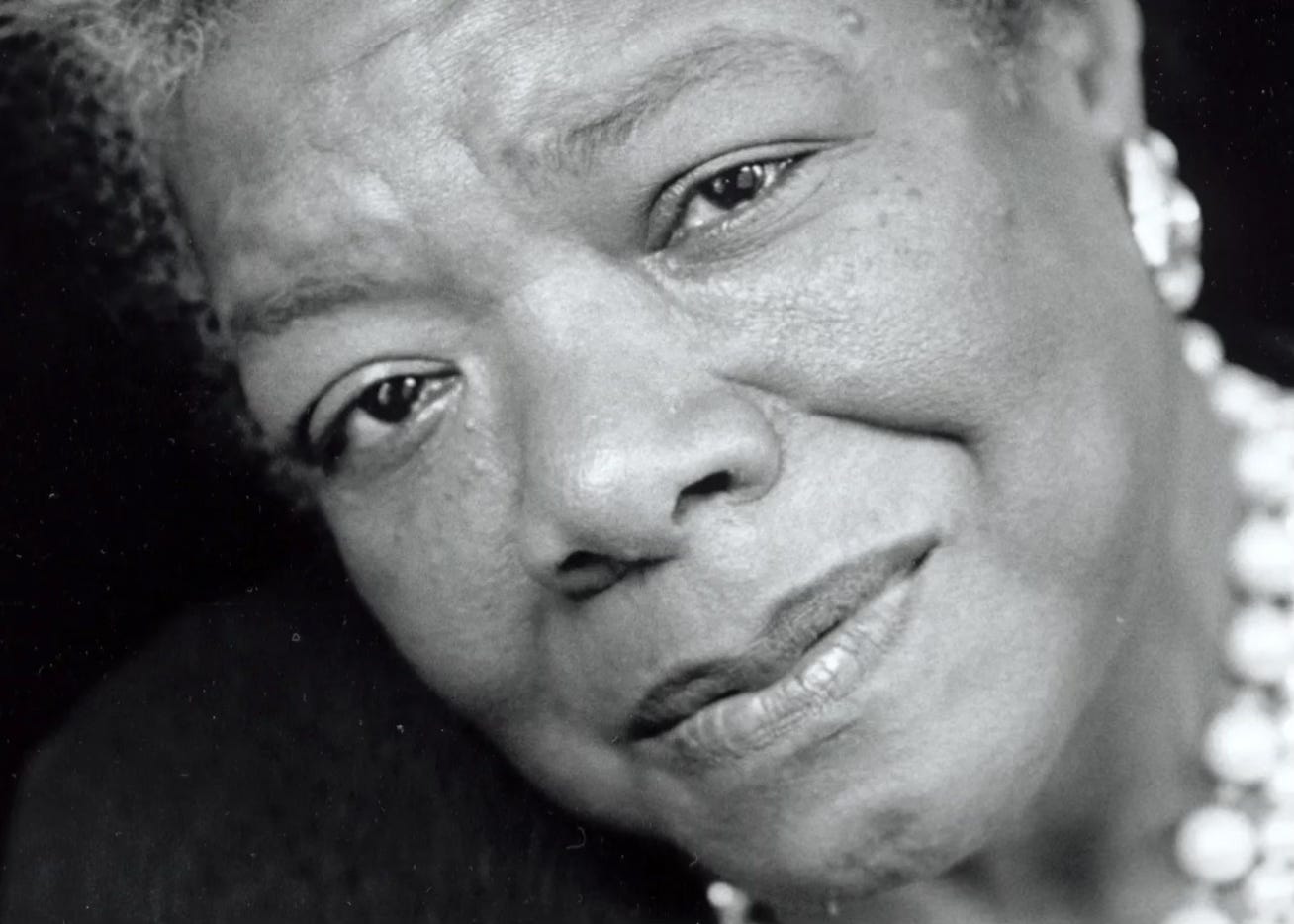
MAYA ANGELOU | “Easy reading is damn hard writing.”
Dear Faithful Reader,
Many years ago, Ana and I were about to lead a major teleconference for a business client. It was an early evening call. We got the dogs quieted down. Dinner dishes in the sink. Phones turned off, laptop ready. The moment arrived. With over 100 people on the line, we began.
And the dogs chose that moment to start barking.
I hit the mute button and fiercely whispered Shhh! over my shoulder. “Quiet!” I hissed. They quieted, for a minute or two — and then exploded in a sonic boom of poodlacious bedlam, ark-ark-arking like a drove of hogs being herded to slaughter.
I stabbed at the mute button again, wheeled around in my seat and shouted at the top of my lungs:
“I – Said – QUIET!!”
Except that, as it turned out, I hadn’t quite hit the mute button.
Oops.
A few weeks ago, I was guest on a podcast that experienced some technical glitches. We got through it alright, and my host thanked me afterward for being so gracious and professional throughout.
Yeah, well, I wanted to say. You should have seen the rehearsal.
My point is this: It takes a certain amount of getting it wrong to get it right.
My favorite living violinist is Hilary Hahn, and as much as I love seeing her in concert, I equally love watching her reels on Instagram (@violincase), which typically consist of nothing more than her practicing a particular passage over and over again. I find it fascinating to see how she gets from here to there, from the kludgy hotel-room repetitions to the exquisite concert-hall execution. To watch this virtuoso struggle to get it just right.
There is a line from The Recipe where the old Chef tells the boy Owen:
The world may applaud when they see you make it across the finish line, Owen. What they don’t see is how hard it was just to get to the starting line.
You know how a star athlete or great dancer looks when they’re in their element? That effortless, transcendent grace? They do the most amazing things, and they make it look easy, like it comes naturally.
It doesn’t.
Every writer knows this. When Maya Angelou says, “Easy reading is damn hard writing,” she’s actually quoting Nathaniel Hawthorne, and dozens of other notable pens, from Lord Byron to Anthony Trollope, have voiced the same thought.
Angelou’s remarks came in an interview she conducted live on stage at the 92nd Street Y on Manhattan’s Upper East Side in January 1988, later recorded here in The Paris Review. Angelou went on to say:
I try to pull the language in to such a sharpness that it jumps off the page. It must look easy, but it takes me forever to get it to look so easy. Of course, there are those critics—New York critics as a rule—who say, Well, Maya Angelou has a new book out and of course it’s good but then she’s a natural writer. Those are the ones I want to grab by the throat and wrestle to the floor because it takes me forever to get it to sing. I work at the language.
I like what that legendary early-twentieth-century journalist and screenwriter Gene Fowler said about the process:
Writing is easy. You just stare at a blank page until drops of blood start to form on your forehead.
Why do we do it? What makes athletes and dancers toil for years on end to perfect those movements, violinists to master those awkward left-hand acrobatics, writers to pour hours and days and years into shaping those phrases and story arcs and plotlines that land in their readers’ hands as such fluid, effortless reading?
I think the answer comes down to a single word.
Devotion: n. 1. love, loyalty, or enthusiasm for a person, activity, or cause; 2. a religious worship or observance.
Becoming proficient at anything requires climbing a mountain, sometimes an entire range of mountains. Sometimes on our hands and knees. It is a kind of pilgrimage, isn’t it, an act of love, loyalty, and passionate enthusiasm for a person, activity, or cause. A path of devotion.
“Devotion” comes from a root word meaning make a promise, the same root word that gave us vow. And that’s why we do it. We take a vow, make a promise out of love.
It’s that promise, that love, that devotion, that makes the struggle worth it.
So my question for you:
What promises to yourself lie at the heart of what you do every day? Or put it this way: To what are you devoted? (If you trust me enough to share this, REPLY HERE — I would love to read your answer!)
To open the second half of our book The Go-Giver Marriage, the part that comes after the parable, Ana and I wrote a passage under the heading, “Love Is a Practice.”
You’ve probably heard the expression “Practice makes perfect.” We don’t think this is true. Becoming perfect would mean there’d be no more room to improve and grow. In our experience, practice does not make you perfect — but it does make you better.
This is true for anything you do. It’s true for dancing, painting, carpentry, and baseball. For teaching, parenting, and coaching. It’s true for the practice of prayer and the practice of meditation.
And it’s true for lasting love.
It might not seem like love should be something you practice at — yet it is. Love can be a bolt from the blue, something that wallops you at first sight … or it can blossom over time from a friendship. But whatever form love takes, love that endures — lasting love — is a practice.
Ana and I have both had our share of heartache and relationship disaster. We have both scaled that particular mountain on hands and knees. (This is not the first marriage for either of us.) Yet we’ve arrived at a summit of sorts, a place where our life together feels effortless. Like an Olympic skater floating over the ice, or a narrative phrase curling effortlessly off the page and into a thousand readers’ imaginations.
It feels like it comes naturally, without effort.
Mastering anything may leave you with scraped hands and bloodied knees — but oh, isn’t the view from that mountaintop breathtaking?
My October wish for you:
That you identify something you’ve been thinking about doing for a long time — and start doing it.

About the writer
Born Marguerite Annie Johnson in 1928 — nicknamed “Maya” (as in “mya sistah”) by her big brother Bailey, and later taking the stage name “Angelou” borrowed from an ex-husband, a Greek aspiring musician named Tosh Angelos — the woman who would become Maya Angelou had a uniquely resonant relationship with the power of words.
When Marguerite was three and her brother was four, their parents’ “calamitous marriage” ended and the two were shuffled off from St. Louis to the tiny rural outpost of Stamps, Arkansas, to live with their grandmother. (They arrived at the train platform unaccompanied and wearing tags on their wrists that said, “To Whom It May Concern.”)
Four years later, they were sent back to live with their mother.
A year after returning to St. Louis, Marguerite was raped by her mother’s boyfriend, a man named Freeman. She confessed what had happened to Bailey, who told the rest of their family.
Freeman was arrested, tried, found guilty and sentenced to a year and a day, but ended up being released that same day. Four days days later his murdered corpse was found out behind the local slaughterhouse, probably done in by Marguerite’s uncles.
Poor little eight-year-old Marguerite was traumatized not only by the assault itself, but also by the conviction that it was her naming him that had caused the man’s death. As she recalled years later in a BBC interview:
I thought, my voice killed him. I killed that man, because I told his name. And then I thought I would never speak again, because my voice would kill anyone.
As she reports in her memoir, she already had a reverence for the nearly supernatural power of the spoken word:
“[I thought that] if I talked to anyone else that person might die too. Just my breath, carrying my words out, might poison people and they’d curl up and die. I had to stop talking.”
And stop talking she did. For the next five years, the young girl declined to speak to anyone, save her brother and confidant, Bailey, and then only in private.
I discovered that to achieve perfect personal silence all I had to do was to attach myself leechlike to sound. I began to listen to everything.
It was during this self-imposed vow of silence that young Marguerite developed her uncanny ability to listen and observe the world around her, her exceptional memory for detail, and especially her love for books and literature.
At first her behavior was accepted as a normal response to trauma, “a post-rape, post-hospital affliction.” But soon the grownups grew impatient. She was thrashed for being “uppity.” Eventually, she and Bailey were sent back to the backwater of Stamps to live with their grandmother again — a banishment she welcomed.
The barrenness of Stamps was exactly what I wanted, without will or consciousness. After St. Louis, with its noise and activity, its trucks and buses and loud family gatherings, I welcomed the obscure lanes and lonely bungalows set back in deep dirt yards. … In Stamps, nothing happened. Into this cocoon I crept.
A year after arriving back in Arkansas, Maya met a woman who would change her life.
Mrs. Bertha Flowers was the aristocrat of Black Stamps. She had the grace of control to appear warm in the coldest weather, and on the Arkansas summer days it seemed she had a private breeze which swirled around her, cooling her.
Her skin was a rich black that would have peeled like a plum if snagged, but then no one would have thought of getting close enough to Mrs. Flowers to ruffle her dress, let alone snag her skin. She didn’t encourage familiarity.
Nevertheless, Mrs. Flowers must have seen something special in Maya, because she took to the girl, tucking her under her wing and bonding with her over the sacrament of great literature.
In her memoir, I Know Why the Caged Bird Sings, Angelou introduces Mrs. Flowers as “the lady who threw me my first life line,” then adds, “She has remained throughout my life the measure of what a human being can be.”
It was Mrs. Flowers who drew her back into speaking again, telling her:
“No one is going to make you talk — possibly no one can. But bear in mind, language is man’s way of communicating with his fellow man. Your grandmother says you read a lot. That’s good, but not good enough. Words mean more than what is set down on paper. It takes the human voice to infuse them with the shades of deeper meaning … You do not love poetry — not until you speak it.”
She started lending books to Maya, one by one, on the condition that the girl would read them aloud. She introduced her to Charles Dickens, William Shakespeare, Edgar Allan Poe, the African-American playwright Georgia Douglas Johnson, the poet, novelist, and civil rights activist James Weldon Johnson, and other authors who would have a profound impact on Angelou’s life and career.
Maya began to speak — and man oh man, did that uncaged bird sing.
Over the course of the next seven decades she would publish articles, short stories, TV scripts, documentaries, collections of essays, collections of poetry, and seven autobiographies.
She would write, produce, and narrate a a ten-part documentary series about the blues and Black Americans’ African heritage, write film scripts, compose movie scores, pen songs for Roberta Flack, produce plays, appear in the landmark TV mini-series Roots, direct a feature film (Down in the Delta, featuring Alfre Woodard and Wesley Snipes), collaborate on albums that would make the Billboard charts.
She would be named visiting professor at a handful of colleges and universities, receive more than fifty honorary degrees from colleges and universities around the world, win a Tony nomination, a Pulitzer nomination, three Grammys, and be awarded the National Medal of Arts and the Presidential Medal of Freedom.
She would become the first Black woman to be depicted on the back of a quarter.
But that was all in the future. Marguerite Johnson had not yet become Maya Angelou.
At 14 she moved with her brother back in with her mother, now living in Oakland, California. At 16 she took a job as a streetcar conductor (the first Black woman ever to do so). At 17, shortly after receiving her high school diploma, she gave birth to a son.
Over the next decade she pursued a career as a dancer, dancing professionally in the San Francisco nightclubs, forming a company with Alvin Ailey, working up a calypso song and dance act, cutting an album called Miss Calypso, and appearing in an off-Broadway review that inspired the 1957 film Calypso Heat Wave, in which she sang her own compositions.
When she toured Europe with a production of Porgy and Bess, she began what became a lifelong practice of picking up the language in each country she visited. She became fluent in at least five languages — again, her flourishing love of words.
In the late 1950s Angelou moved to New York City to pursue her writing; she joined the Harlem Writers Guild and was published for the first time. She relocated briefly to Cairo, where she worked as associate editor at an English-language weekly, then to Ghana, where she was a feature editor for The African Review, a freelance writer for the Ghanaian Times, wrote and broadcast for Radio Ghana, and worked and performed for Ghana’s National Theatre.
It was in Ghana that she befriended Malcolm X and became actively involved in the civil rights movement. She returned with Malcolm to the States to help him establish the Organization of African American Unity.
A few years later, at Martin Luther King, Jr.’s invitation, she began serving as northern coordinator for the Southern Christian Leadership Conference. She was in the midst of organizing a march for King in 1968 when the plan was cut short by his assassination.
King was shot on April 4, 1968: Angelou’s fortieth birthday. For decades after, she refused to celebrate her birthday, marking the occasion instead by sending flowers to Coretta King.
In the aftermath of King’s murder, along with that of her friend Malcolm X three years earlier, Maya sunk into a deep depression, from which she was pulled out in large part by her friend James Baldwin, a fellow civil rights warrior and lover of words. Baldwin, along with the cartoonist Jules Feiffer and Random House editor Robert Loomis, challenged Angelou at a dinner party to write her first full-length book, an autobiography.
Out of that dinner-party conversation came a lifelong collaboration with Loomis (who would be her editor throughout her career), and the book that skyrocketed Angelou to international fame.
Covering the events of her life from age three to 17, I Know Why the Caged Bird Sings was the first of what would become a series of seven autobiographies written over the length of her career. It hit the New York Times bestseller list and stayed there for two years. It is still today the most influential memoir by a Black woman; Time magazine ranked it one of the 100 most influential books of the 20th century.
What I cannot adequately convey here is the humor, wry sweetness, and poignancy of the writer’s prose. Despite its underpinnings of abuse, sexual trauma, and racial oppression, I Know Why the Caged Bird Singsis not a grim book — the opposite, in fact, a lyrical yet ironic, unabashed yet exquisitely sensitive celebration of life.
If you’ve never read it before, you are in for a treat.
Recommended Reading
If you’ve never read any Angelou, here are some suggestions for where to dip your toe into the water:
I Know Why the Caged Bird Sings (1969), her classic debut autobiography.
Gather Together in My Name (1974), the second volume of her memoirs.
And Still I Rise (1978), her powerful, uplifting poetry collection.
Let me know if you read any of these and fall in love!
Is there a book in you, waiting to be written? A story you’ve been wanting to tell, an expertise you need to share? Consider joining our community of writers in my one-year coaching program, Writing Mastery Mentorship.